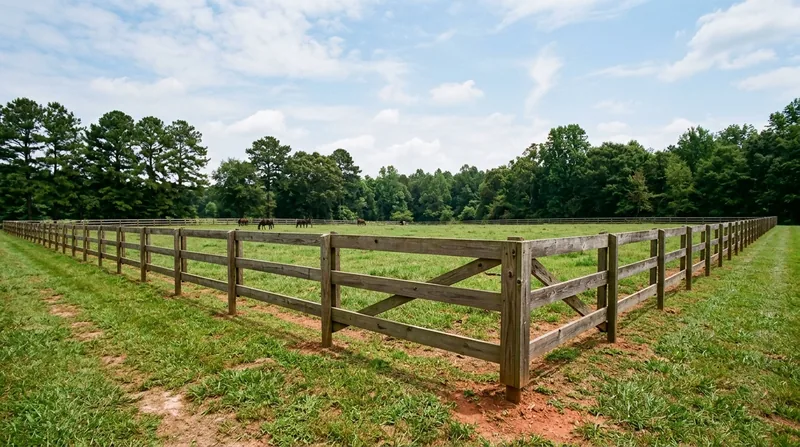




Farm fence installation in Greensboro means durable perimeter fencing built to handle livestock, property lines, and the Piedmont terrain that defines our region. Whether you're securing pasture for horses, containing cattle across acreage, or marking a long property boundary on sloped red clay soil, the fence you choose has to stand firm against seasonal water saturation, wind load, and years of use. Greensboro and the surrounding areas see a mix of established rural holdings and newer suburban acreage where fencing becomes both functional and a neighborhood boundary statement. We install ranch rail, no-climb horse fence, field wire, pipe fencing, and split rail systems sized for trailers, gates, and real working conditions. Our crew has been installing and repairing farm fencing since 2015, and we know the soil, the frost line, the species of wood that hold up here, and the bracing that keeps a corner square over decades.
Why Farm & Ranch Fencing Matters in Greensboro's Growing Acreage Communities
Greensboro and the surrounding Piedmont are seeing more families move to larger lots and small acreage properties in areas like Summerfield, Oak Ridge, and Kernersville. That shift brings real fencing needs: livestock containment, property definition, and the practical challenge of installing on sloped terrain with clay that holds water after rain. A post set in saturated clay without proper concrete and drainage will rot at the ground line within five to seven years, turning a ranch rail fence into a liability. The combination of spring thaw, summer storms, and our heavy red clay soil means that post spacing, concrete depth, and bracing strategy separate a fence that lasts from one that fails early.
- Livestock containment requires no-climb horse fence or field wire sized to prevent injury and escape, with posts set deep and braced at corners to handle lateral load.
- Property line fencing on sloped lots calls for racked installation (stepped boards following the slope) or careful grading to prevent water pooling at the base.
- Ranch rail and split rail fencing work best with 6-foot post spacing and concrete-set posts on clay to resist frost heave and seasonal movement.
- Gate sizing and placement must accommodate farm equipment, trailers, and emergency access without forcing sharp turns or low clearance.
- Braced corners and anti-sag hardware prevent the sagging and twisting that develops when a long run of fence meets wind and time without reinforcement.
Getting the design and materials right on the first install saves years of repair and replacement down the road.
Key info: The Greensboro area's Piedmont clay drains slowly and stays saturated longer than sandy or loamy soil. Posts must be set in concrete, not just tamped, and set deeper than the frost line to prevent heave. Cedar and pressure-treated pine both work, but the choice affects cost and longevity on wet ground.
For guidance on local permit requirements and setback rules, check the City of Greensboro Planning Department and your county zoning office, as rules vary across the service area.
How We Install Farm & Ranch Fencing in Greensboro: A Step-by-Step Process
We start with a site walk to assess the terrain, identify utilities, check for setback and HOA rules, and confirm your property line. From there, we mark the fence line, call for a North Carolina 811 utility locate to mark buried lines, and plan post placement and gate locations. On sloped lots, we decide whether to rack the fence (stepping the boards to follow the slope) or step the posts themselves. We then dig post holes, set posts in concrete, allow cure time, and build the fence structure. Every job gets measured, and we work to the linear foot you're paying for.
- We confirm property lines, setback requirements, and local permit rules before we begin, so you avoid costly moves later.
- We call 811 for utility locates at no cost to you, because hitting a buried line creates liability and delays.
- We set posts in concrete to depth below the frost line, ensuring stability through freeze-thaw cycles and seasonal clay movement.
- We brace corners with diagonal or cross-bracing to handle the lateral load that long runs and livestock pressure create over time.
- We install gates with self-closing, self-latching hardware and size them for the equipment and trailers you need to move through.
The result is a fence that holds its line and resists sagging, twisting, and premature rot.
Real example: A 5-acre horse property in Stokesdale with a sloped western boundary and heavy clay needed no-climb horse fence on a racked installation to follow the grade. We set posts 3 feet deep in concrete, spaced them 6 feet apart, and installed diagonal corner bracing at the high and low points. The fence has held tight for six years without sagging or twisting, and the horses respect the no-climb mesh.
Learn more about our gate installation and repair services for driveway and pasture gates that complement your farm fencing.
Farm & Ranch Fencing Installation Methods for Greensboro Acreage
| Approach | Description | Best for |
|---|---|---|
| Ranch Rail Fencing | Horizontal rails (typically 2x6 or 2x8 pressure-treated pine) mortised or bolted to posts, with 6-foot spacing and concrete-set posts. | Large acreage, cattle, decorative property lines, and areas where visibility and light penetration matter. |
| No-Climb Horse Fence | Welded mesh or woven wire with small openings (2x4 inch or smaller) attached to posts with tension bands and stretcher bars, preventing hooves from catching. | Equestrian properties, horse containment, and pastures where safety and escape prevention are non-negotiable. |
| Split Rail Fencing | Rustic hand-split or sawn rails mortised into posts, typically 2 or 3 rails high, installed on level or racked (stepped) on slopes. | Rural properties, heritage aesthetics, and sloped terrain where a stepped installation follows the grade without sharp angles. |
| Pipe and Field Wire Fencing | Welded steel pipe posts with field wire (woven or barbed) stapled or clipped to the posts, offering durability and low maintenance on long runs. | Large acreage with livestock, areas prone to wind and weather stress, and where minimal upkeep and longevity justify the higher material cost. |
| Barbed Wire Fencing | High-tensile barbed wire strung between posts with tension bands and stretcher bars, requiring periodic retensioning as wire relaxes over time. | Cattle containment, large perimeter fencing where cost per linear foot is critical, and properties where wire height and spacing are set by use. |
Farm & Ranch Fencing Cost in Greensboro: What to Expect
Ranch rail and no-climb horse fence start at approximately $12 to $18 per linear foot installed, depending on material choice, post spacing, terrain, and whether bracing or gates are included. Split rail runs slightly lower at the entry, while pipe and field wire systems scale with the material cost and the size of your acreage. A 200-foot perimeter on level ground with simple ranch rail and one gate will run differently from a sloped 800-foot boundary with multiple gates, corner bracing, and no-climb mesh. Soil type, access for equipment, and whether you need removal of old fencing also move the total. The best way to understand cost for your property is to get two or three on-site estimates so you can compare materials, post spacing, bracing strategy, and gate placement side by side.
Visit our pricing page for a full breakdown of farm and ranch fencing costs and what drives variation across job size and material choice.
Farm & Ranch Fencing Near Me: What to Look for When Hiring in Greensboro
Finding the right fence contractor means checking three things: insurance, understanding how fencing licensing works in North Carolina, and confirming that the crew has real experience with the specific fence type and terrain you need. North Carolina issues no state license for fence installation, and projects below $40,000 do not require a licensed general contractor. We are fully insured with general liability and workers' compensation cover, and we offer a certificate of insurance on request. Beyond that, ask to see examples of similar work, check references from customers in your area (Greensboro, High Point, Kernersville, or Summerfield), and confirm that the estimate includes site-specific details like post depth, bracing, and gate sizing rather than generic pricing.
- Verify that your contractor carries general liability and workers' compensation insurance, and ask for a certificate of insurance before work begins.
- Confirm that the estimate includes a site walk, utility locate, and written plan showing post spacing, material choice, and gate locations.
- Ask whether the contractor has experience with racked installation on slopes and concrete-set posts in clay soil, since that's the standard in Greensboro.
- Check local zoning and HOA rules yourself or ask the contractor to confirm setback and height requirements before the estimate, so there are no surprises.
- Get at least two estimates so you can compare post spacing, material grade, bracing strategy, and warranty or follow-up commitment.
A crew that takes time to understand your property and explains why they're making specific choices will deliver a fence that lasts.
Call us at (336) 962-6449 or request a free estimate to discuss your farm or ranch fencing project. We respond within 24 hours and work across Greensboro, High Point, Jamestown, Kernersville, Winston-Salem, Summerfield, Oak Ridge, and surrounding areas.
Farm & Ranch Fencing in Greensboro: Pricing Guide
| Service | Price | Details |
|---|---|---|
| Ranch Rail Fencing | From $12/ft | Horizontal pressure-treated rails on concrete-set posts, 6-foot spacing, includes basic corner bracing on level terrain |
| No-Climb Horse Fence | From $15/ft | Welded mesh with tension bands and stretcher bars, concrete-set posts, includes corner bracing and one pasture gate |
| Split Rail Fencing | From $10/ft | Sawn or hand-split rails mortised to posts, racked or stepped installation on slopes, concrete-set posts with diagonal bracing |
| Pipe and Field Wire Fencing | From $14/ft | Welded steel pipe posts with woven or barbed field wire, high durability on large acreage, minimal maintenance over decades |
| Gates and Bracing | From $200 | Pasture gates sized for equipment, self-closing hardware, and diagonal or cross-bracing at corners to prevent sagging and twisting |
| Free Estimate | No charge | Site walk, utility locate coordination, material review, and written plan with post spacing and gate locations, response within 24 hours |
Indicative pricing, the exact cost depends on square footage, finish, and site access. Free personalized estimate within 24h at (336) 962-6449.


